
How does a common rail diesel system work? Follow the fuel from the tank to the injector needle, step by step, and see where rail pressure really comes from.
The Big Picture in One Sentence
A common rail diesel system pressurizes fuel in a central pump, stores it in a shared rail at up to 2,000 bar or more, and lets electronically triggered injectors release it into each cylinder at exactly the right microsecond. Simple to say. Fascinating in the details.
Step 1: Low-Pressure Fuel Supply
It starts quietly. A supply pump (often driven off the high-pressure pump) draws diesel from the tank through the filter and pushes it toward the high-pressure pump at a modest 3–5 bar. This stage matters more than people think — a clogged filter or weak supply pump is one of the most common causes of 'mystery' rail-pressure faults.
Step 2: The Metering Unit Decides How Much Fuel Gets Pressurized
Before fuel enters the high-pressure pump, it passes the diesel fuel pressure regulator, also called the fuel metering unit or inlet metering valve. This is an electrically controlled valve: the ECU opens or closes it to decide how much fuel the pump is allowed to compress. It's the system's throttle — and one half of the pressure-control loop.
Step 3: The High-Pressure Pump Builds the Rail Pressure
Inside the pump, pistons driven by the engine drive fuel up to operating pressure — typically 1,200–2,000 bar (120–200 MPa) on most road diesels, with the newest systems exceeding 2,500 bar. From here the fuel flows into the high pressure accumulator rail, a forged steel tube that stores the pressure and smooths out the pump's pulsing delivery.
Step 4: The Closed Loop Keeps Pressure on Target
A pressure sensor screwed into the rail reports the actual pressure to the ECU hundreds of times per second. The ECU compares that reading with the target for the current engine condition and nudges the metering unit open or closed. Rail pressure therefore stays rock steady — completely independent of engine speed — which is the single biggest advantage over old cam-driven pumps.
Step 5: Inside the Injector — the Needle Standoff
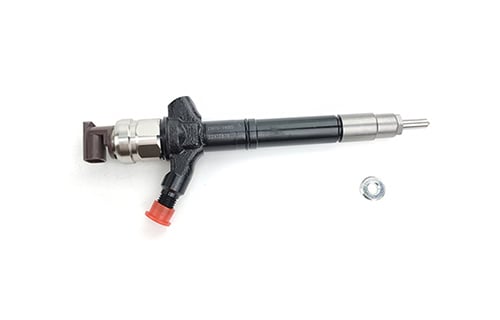
Here's the clever hydraulic trick at the heart of every injection event. High-pressure fuel enters the injector and fills two chambers — one above the needle's control piston, one below the needle itself. The forces roughly balance, and a small spring tips the scale so the needle stays closed.
The upper chamber, called the control chamber, connects to a drain through the injector's common rail control valve — a solenoid or piezo valve.
Step 6: The ECU Fires the Injector
When the ECU sends its pulse, the control valve opens and vents the control chamber. Pressure above the needle collapses, while full rail pressure still pushes up from below. The needle lifts — that's injector needle lift — and fuel sprays through the nozzle into the combustion chamber, where it ignites almost instantly in the hot compressed air.
Step 7: Closing the Event Cleanly
Injection ends the moment the ECU cuts the pulse. The valve snaps shut, rail pressure refills the control chamber, the needle is forced back down onto its seat, and the spray stops dead. That clean cut-off is what makes precise, split injection strategies possible at all.
Frequently Asked Questions
Why does rail pressure stay constant at idle?
Because pressure lives in the accumulator rail, not in the pump's delivery stroke. The metering unit simply feeds the rail whatever it needs to hold the ECU's target.
What's the difference between solenoid and piezo injectors?
Both use the same control-chamber principle. Piezo actuators switch faster, enabling finer injection shaping; solenoids are cheaper and extremely robust.
Why do these systems hate dirty fuel?
At 2,000 bar, a particle that would pass harmlessly through a mechanical pump grinds through injector clearances measured in microns. Fuel quality and filter service intervals are not optional.
The Bottom Line
Once you follow the fuel's path — supply, metering, pressurizing, storing, then the needle's delicate balancing act — how common rail works stops being a black box. And if you're diagnosing one, that mental model tells you exactly which component to check first.