
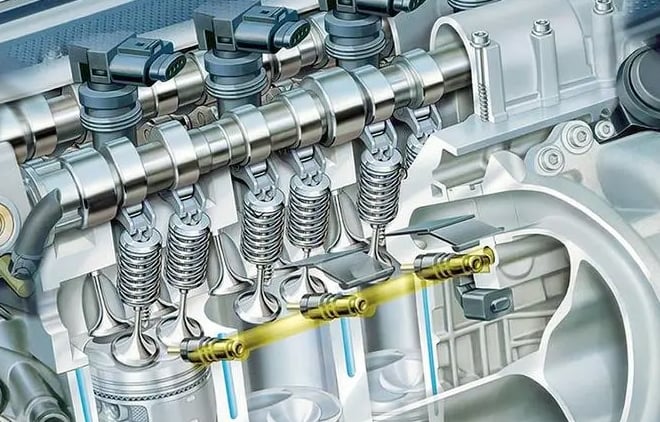
Why is the electronic fuel injector the hardest part of a common rail system to build? See how spray quality and solenoid control deliver diesel precision.
Why the Injector Decides Everything
Ask any diesel engineer which part of a common rail system keeps them up at night, and you'll get the same answer: the electronic fuel injector. It's the single most critical — and most complicated — component in the whole chain. It has to open and close in fractions of a millisecond, meter fuel to an accuracy of a single cubic millimetre, and survive thousands of hours bathed in fuel at pressures that would cut steel.
The reason is simple. The ECU can calculate the perfect injection event, and the rail can hold the perfect pressure, but if the injector can't atomize that fuel into a fine, well-directed spray, combustion suffers. Power drops, smoke rises, and the emissions the system was designed to control go straight out the tailpipe.
What Makes an Electronic Fuel Injector So Demanding
Micron-Level Machining
A common rail injector is machined to tolerances measured in microns. The nozzle holes themselves can be smaller than a human hair, and the needle and seat must seal perfectly at 2,000 bar — then lift smoothly, thousands of times per minute. That's why injectors cost what they do, and why cheap remanufactured units so often disappoint.
A Wide Dynamic Flow Range
The injector must deliver a tiny pilot dose at idle and a full-power shot at wide-open throttle, using the same hardware. Its dynamic flow range spans roughly 20:1 or more, and the quantity error has to stay within a few percent across all of it. Throw in the need to resist clogging and contamination from real-world diesel, and the design challenge becomes obvious.
Spray Quality: The Performance You Can't See
Spray characteristics are where an injector earns its keep. Engineers specify several parameters, and each one shapes combustion:
· Atomization — droplet size has to be small enough to vaporize quickly in hot compressed air.
· Spray pattern and distribution — fuel must spread evenly through the combustion chamber, not pool on the piston.
· Penetration and cone angle — the spray has to reach across the bowl without wetting the cylinder walls.
Get these right and the air-fuel mixture burns completely, delivering strong torque and good fuel economy. Get them wrong and you get smoke, soot and wasted fuel — no ECU tuning can fix a bad diesel injector spray pattern.
Inside the Injector: Solenoid, Piezo and the Hydraulic Servo
Solenoid Injectors
Most injectors use an electromagnetic solenoid valve. When the ECU sends its pulse, the valve opens a small control orifice, pressure above the needle drops, and the needle lifts against the rail pressure below it. Injection ends the instant the valve closes and the control chamber re-pressurizes.
Piezo Injectors
Piezo units replace the coil with a stack of piezoelectric crystals that expand almost instantly when voltage is applied. They're faster and allow even finer control of injection rate — at a higher price. The piezo injector vs solenoid debate in the workshop usually comes down to this: piezo for ultimate precision, solenoid for durability and cost.
Why the Operating Environment Is So Brutal
Remember what the injector faces. A diesel engine compresses pure air to 3.5–4.5 MPa and 750–1,000 K before fuel even arrives — compare that to a gasoline engine's 0.6–1.2 MPa. Fuel is injected into that furnace and ignites almost immediately, with cylinder pressure spiking to 6–9 MPa within microseconds. The injector sits at the center of that violence, every cycle, for its entire life.
Frequently Asked Questions
What are the first signs of a failing CRDI injector?
Rough cold idle, a fuel knock at low rpm, increased smoke under load, and fuel dilution in the engine oil are the classic warnings.
Can injectors be cleaned instead of replaced?
Ultrasonic cleaning helps with external deposits and sticking needles, but it can't restore worn seats or eroded nozzle holes. Internal wear is permanent.
Why do injectors need coding to the ECU?
Each injector's flow characteristics are measured at the factory and printed as a correction code. The ECU uses that code to equalize fuel delivery across cylinders.
The Bottom Line
The electronic fuel injector is where diesel engineering meets its hardest physics. Respect it with clean fuel, fresh filters and quality parts, and a common rail engine will reward you with quiet, clean, effortless torque for a very long time.