
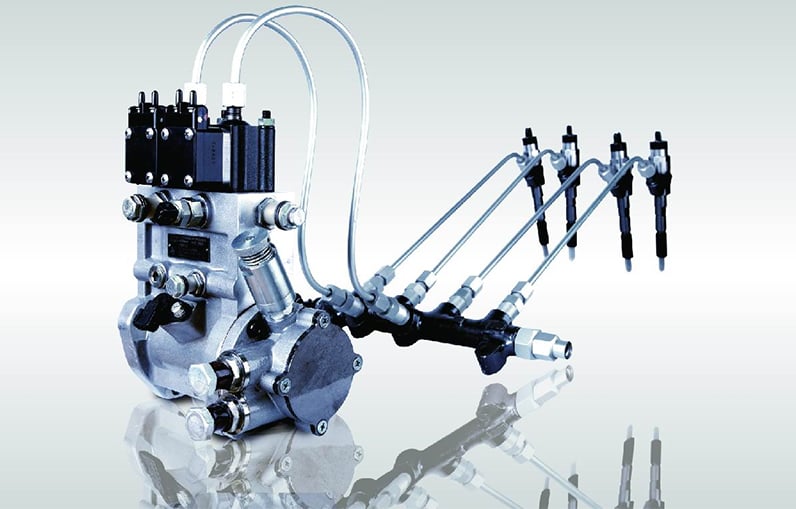
Marine duty mixes steady cruising load with long idling in harbour. Common rail has to deliver repeatable quantity at both ends of that range.
A marine engine spends hours at a steady cruising load and then hours idling while manoeuvring. A common rail system has to deliver the same fuel quantity at both ends of that range, and it has to do so with fuel that may have picked up water in the tanks.
Two duty points, one calibration
At cruising load the rail holds a high pressure and the injection duration is short; at idle the pressure drops and the duration lengthens. Because timing is calculated from the crank signal rather than from a pump plunger, the engine keeps a stable idle even when the propeller load changes with sea state.
Water and fuel quality
The injector and the high-pressure pump are the first components to suffer from water or biological growth in marine fuel. Water reaching the rail shows as a scored pump plunger and a leaking pressure control valve, and the symptom is a rail that cannot reach its setpoint at high load. Filters and water separators protect the rail far more cheaply than a pump overhaul.
Spares worth carrying on board
Carry injector sealing washers, a return line kit and the correct filters for the engine rather than a full spare injector set. When an injector does have to be replaced at sea, having the exact part number from the engine plate removes the guesswork that usually causes the delay.