
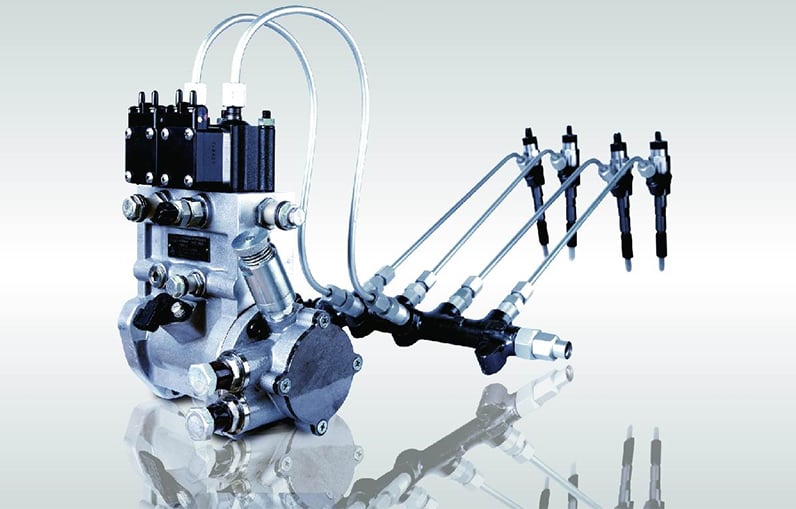
How does common rail electronic fuel injection beat old mechanical pumps? See how the ECU controls fuel pressure, timing and quantity completely independently.
From the Mechanical Pump to the Electronic Brain
Diesel fuel injection has come a long way in thirty years. Early systems were purely mechanical: a cam-driven pump metered fuel, and whatever the engine speed was, that was the pressure and timing you got. Then came electronic controls, first governing position (how far a control rod moved) and later governing time (how long the metering event lasted). Common rail electronic fuel injection belongs to that second, time-control generation — and it changed the game completely.
The big idea: stop asking one pump to do two jobs. Instead, generate pressure in one place, store it, and let smart valves decide when and how much fuel actually enters the cylinder.
How Common Rail Electronic Fuel Injection Works
Sensors scattered around the engine — crankshaft and camshaft position, rail pressure, boost pressure, intake air mass, coolant and fuel temperature — stream live data to the electronic diesel control unit. The ECU compares that picture against the driver's request on the accelerator pedal and computes four things:
· Injection quantity — how much fuel the cylinders need right now.
· Rail pressure — the injection pressure that best suits the current load and speed.
· Injection timing — the exact crank angle where fuel should arrive.
· Injection rate — how fuel is delivered across the event, including any split injections.
Commands go out to two actuators: the pressure control valve on the pump, and the injectors themselves. Because rail pressure is held in a reservoir, it stays constant regardless of rpm — the system delivers full injection pressure even at idle, something no old mechanical pump could do.
Why Split Injections Matter So Much
This is where CRDI technology really distances itself from the past. Instead of one harsh shot of fuel, the injector can fire several smaller ones in a single cycle:
· Pilot injection — a micro-dose before the main event that pre-heats the chamber and smooths pressure rise, cutting the diesel 'knock'.
· Main injection — the bulk of the fuel, shaped for power and efficiency.
· Post injection — a late shot used for exhaust-temperature management and DPF regeneration.
That flexibility lets engineers walk the classic tightrope between NOx and particulate matter. Add a small pilot and you can run higher pressures — cleaner combustion, sharper response — without the noise and smoke that once came with them.
The Hardware Behind the Logic
Sensors: The System's Eyes and Ears
The rail pressure sensor is the most important of the group; its signal closes the loop on pressure control. Cam and crank sensors give the ECU its timing reference within a fraction of a degree.
Actuators: Where Software Meets Fuel
Fast solenoid or piezo valves inside each injector execute the ECU's pulses. An injector typically opens in well under a millisecond — and the fuel it releases depends on rail pressure multiplied by valve open time, which is precisely why pressure and timing can be tuned fully independently.
What the Driver Actually Feels
The payoff shows up in everyday driving. Diesels with this technology typically burn around 30% less fuel than a comparable gasoline engine, produce peak torque much lower in the rev range, and — thanks to pilot injection — idle far more quietly than older diesels ever managed. Modern diesels still carry a weight and cost penalty, but the old trade-offs of noise, smoke and harshness have largely been engineered away.
Frequently Asked Questions
Is common rail the same as direct injection?
Direct injection only means fuel goes straight into the cylinder. Common rail describes how that fuel is pressurized and metered — a common rail engine is always direct injection, but not every direct-injection diesel uses common rail.
What happens when a sensor fails?
The ECU falls back on modeled values and limits engine output. You'll usually see a warning light and noticeably reduced power — limp mode — until the fault is fixed.
Does common rail improve emissions?
Dramatically. Precise pressure and timing control, plus multiple injection events, are the reason modern diesels meet strict NOx and particulate limits without sacrificing drivability.
The Bottom Line
Common rail electronic fuel injection works because it separates pressure generation from metering, then lets a fast computer orchestrate both. Once you see the system that way — sensors in, decisions in the ECU, actuators out — every part under the hood suddenly makes sense.